Student Life
Arrival and the first two weeks: expectations that hold up
The fortnight between landing and the first day of class is where counselling either proves accurate or falls apart. This is what actually happens at Arkansas State University, in order, with the deadlines that sit inside it.

Why this fortnight decides your reputation
Everything a counsellor says before departure is tested in about fourteen days. If the student lands where you said, is met the way you said, and finds the deadlines you warned about, your advice is trusted for the next four years and their family recommends you. If a single element is wrong — the airport, the shuttle sign-up, the check-in window — every other thing you said comes under suspicion at the worst possible moment.
So brief the fortnight properly. The material below is drawn from what Arkansas State University publishes; the parts that vary by student are flagged as questions rather than guessed at.
Getting to Jonesboro
Jonesboro has no international service. The practical arrival airport is Memphis (MEM), roughly 80 miles and an hour and a half from campus, and most itineraries reach it through a large US hub. Little Rock (LIT) is about 131 miles and two hours away and is worth considering only if the fare difference is substantial or someone is collecting the student. Jonesboro's own airport (JBR) is ten minutes from campus but is served by small aircraft with strict baggage limits, which makes it a poor choice for a student arriving with a year's belongings.
At the start of each semester the Office of International Programs runs a free shuttle from Memphis airport to the residence halls for new international students. It has to be booked in advance by emailing oips@astate.edu with the flight number, arrival time and a contact phone number, and the schedule is sent out after the student's I-20 is issued. Book the flight into the shuttle window, not the other way round. A student who arrives outside it needs a taxi or ride-hail from Memphis, or a night at an airport hotel before the next shuttle.
The immigration sequence
These are US federal requirements rather than university policy, and counsellors should present them that way. A student on an F-1 visa may enter the United States up to thirty days before the start date on the I-20. Entry formalities happen at the first US airport, not at Memphis: passport, visa, the signed original I-20 and the SEVIS receipt are presented there, bags are collected and cleared through customs, and re-checked for the domestic leg. Allow at least three hours between flights for a first entry.
After arrival the student must check in with International Student Services, ordinarily within one to three days, so the university can report the enrolment. The documents needed are the passport, the I-20 and the I-94 record, which is printed from the US Customs and Border Protection website. Nothing else in the first fortnight matters as much as this appointment, and it is the one item a counsellor should confirm has happened.
Halls, health and the paperwork week
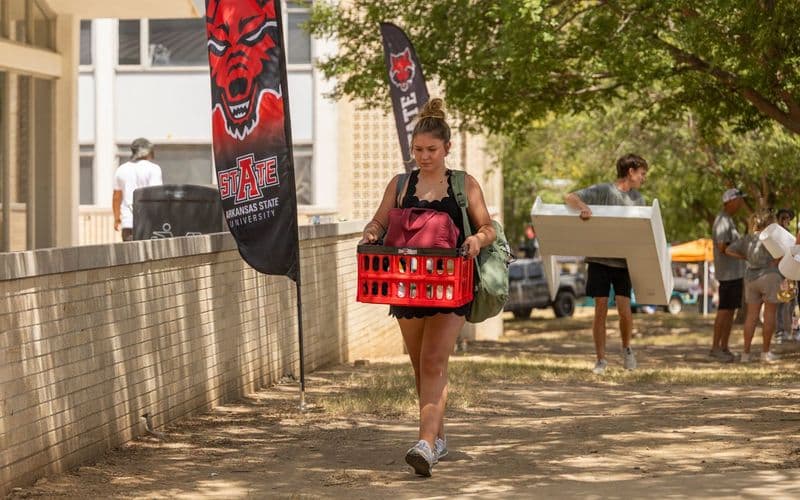
Residence halls open on a published date — 15 August 2026 for the autumn 2026 term — and students are advised to arrive within a few days of opening so they are on campus for orientation. Housing confirmation is needed at the desk to collect a key or card. Bedding and basics are cheaper bought locally in the first week than carried as excess baggage.
Health screening and immunisation are handled on the university's own form. The charge is 280 dollars if the screening is done on campus, with a further 90 dollar administrative charge for tuberculosis and MMR processing, and students should budget roughly 250 dollars more for vaccines and laboratory work, some of which insurance may reimburse. Medication brought from home should travel with an English-language prescription.
Then the ordinary business of becoming a resident: student ID, a bank account, a local SIM. A student with a data connection from the moment they land handles the first day far better than one hunting for a SIM in an airport.
Deadlines hidden inside the first fortnight
This is the section most pre-departure briefings miss. Several administrative clocks start on arrival and run out quickly.
- Payment. Charges for autumn and spring are due on the eleventh class day; in summer, the fifth. Families intending to pay by international transfer should start it before the student flies, not after.
- Refunds. The withdrawal refund window is short — 100 per cent through the fifth class day, 75 per cent on days six to ten. A student wavering about their programme needs to know that the decision has a price after the second week.
- Meal plans. Changes and cancellations close before term. For autumn 2026 the cut-off was five in the afternoon on 12 August 2026, and a student required to hold a plan who did not choose one was assigned the seven-day plan with 310 dollars of flex.
- Assistantships. A funded graduate student must be appointed on or before the eleventh class day for the in-state tuition rate to apply that term.
- English placement. Students entering through the English Language Academy sit a placement test in their first week, which determines which of the six levels they enter. Warn them it is a placement, not an examination to be crammed for.
Getting around, and eating
The GOJO city bus is free with an A-State student ID under a pilot programme running through 15 August 2028, with five routes and nine stops on campus connecting supermarkets, hospitals and the shopping centre. A grocery shuttle for international students runs Monday, Tuesday and Thursday from four to seven in the evening, and Saturday from ten until three, calling at Kroger, Aldi, Walmart and the Asian Food Market. Ride-hail services operate in town and the campus is flat and cyclable.
For a student arriving with limited funds, that shuttle timetable is more useful than any advice about restaurants. Put it in the pre-departure pack.
What the first two weeks feel like
Expect a flat spell around day ten. The arrival adrenaline has gone, the time difference is still there — Jonesboro is many hours behind most sending markets and the gap shifts with daylight saving — classes have started, and the student is doing everything in a second language. This is normal, it is not a sign the placement was wrong, and families who have been told to expect it handle the phone call far better than families who have not.
Practical counters: the student should sign up for A-State Alerts and add family phone numbers, save the University Police number, and use the free evening escort service rather than walking back alone late. Those and the wider support picture are set out on the student life pages and the campus safety page.
Confirm these for each student before departure
- The shuttle window for the specific term, and whether the student's booking has been acknowledged.
- The residence hall opening date and orientation dates for that intake.
- Whether the student's file carries a deposit that is credited against a later term, which is stated in the offer letter.
- The current payment deadline dates for the term, since they are expressed in class days rather than calendar dates.
Deadlines and the recommended preparation timeline sit on the admissions pages, and partners can raise an arrival problem for a named student through the partner channel at any point.
Photo by Oskar Kadaksoo on Unsplash