
History & heritage
One hundred and seventeen years: from an Arkansas farm school to a research university
A-State began with an act of the state legislature, a parcel of donated land, and 189 students taking classes on the floor above a jewellery store. This page tells that story the way the university records it — with dates, with names, and including the parts that are harder to tell.
Founding act
1 April 1909
First classes
3 Oct 1910 · 189 students
University status
17 January 1967
Continuous HLC accreditation since
1928
1909 – 1910
Act 100, donated land, and a room above a jewellery store
On 1 April 1909 the 37th Arkansas General Assembly passed Act 100, creating four agricultural high schools across the state to teach agriculture, horticulture and the art of textile manufacturing. One of the four was placed at Jonesboro, and that school became Arkansas State University.
Victor C. Kays, from Illinois, was recruited as the first principal — a title later changed to president. He began recruiting faculty and building a campus on the donated land straight away. The buildings were not finished in time, so the first classes opened on 3 October 1910 in downtown Jonesboro, in the old Elks Lodge Hall above a jewellery store at Washington and Main.
That first year there were 189 enrolled students and a faculty of eight, Kays included. The entire staff was three people: a secretary, a superintendent of farms and a superintendent of residence halls. Everything else was done by the students themselves. They paid no tuition, but they were expected to work on the campus — that was the arrangement.
Despite the agricultural focus, the "Aggie School" taught a broad curriculum from the outset, with many general education courses using college-level textbooks. Kays also introduced athletics in that first year, along with fine arts programs and a range of extracurricular activities — a decision that shaped campus culture for the century that followed.
Source: Arkansas State University — History · Updated August 2026
1918 – 1929
The 1920s: a war, junior college status, and an arch
The move to a two-year college curriculum came out of the First World War. The Board of Trustees wanted a Student Army Training Corps unit on campus; Kays learned that such units could only be housed at institutions with at least junior college status, so he broadened the curriculum to qualify. The legislature formally recognised the new status in 1925 by changing the school’s name.
The SATC unit was short-lived — the war ended two months after it was assigned. But in 1923 a larger military presence replaced it: an Arkansas National Guard unit, Battery C, 206th Coast Artillery, Anti-Aircraft. A new Armory was built for it, and it included a gymnasium that was the largest in the state.
Also in the 1920s, Aggie opened a Training School covering kindergarten through grade 12, used as a practice laboratory for students preparing to teach. It ran until the 1950s, when education majors began doing their practice teaching in area schools. What survives of it is an arch: it once marked the entrance to the college, it was donated by the Training School, and it is now the oldest structure on campus.
1931 – 1936
The early hours of 12 January 1931, and what happened next
In the early morning of 12 January 1931 — the first day of spring semester classes — a major fire consumed the Administration and Classroom Building. It was a total loss. What is worth remembering is not the fire but the response: Kays found temporary class locations around campus, including the Dairy Barn, and classes continued on schedule.
Construction of a replacement began immediately and the new building opened in 1932. It was named Wilson Hall after Trustee R. E. Lee Wilson of Mississippi County, who provided most of the men, equipment and mules used to build it. In 1933 the Wilson Award was established, recognising the outstanding male and female graduates each year; since the 1980s it has been a single award to one outstanding graduate.
By the 1930s the academic program had grown into a full four-year college curriculum. The first four-year degrees were awarded in 1932, and the following year the school became Arkansas State College.
The Great Depression should have crushed a small college in north-east Arkansas, and instead enrolment and facilities grew. Much of that came from Kays working closely with U.S. Senator Hattie Caraway of Jonesboro to attract federal money to the campus. Work-relief programs and Reconstruction Finance Corporation funds paid for residence halls, a new science building and Wilson Hall itself. On 20 January 1936, ROTC was established as an Artillery unit, with the basic course mandatory for all male students.

1941 – 1951
The Second World War: from 114 students to a campus full of veterans
The growth of the 1930s reversed almost overnight. The campus National Guard unit was activated in January 1941. War was declared that December, men left for service, and enrolment eventually fell to a low of 114 students — most of them women.
Kays went back to Washington and back to Senator Caraway. The way he kept the doors open was by turning the campus into a training school for military units: the Army Administration School, the Army Air Cadets, and an Army Specialized Training Program in engineering. The campus also provided work for German prisoners of war housed at the nearby Civilian Conservation Corps camp.
When the war ended the problem inverted. The influx of returning veterans left the campus bursting at the seams, and temporary housing had to be found — including for students with families. These seasoned combat veterans were very different from students arriving straight out of high school, and they brought their own problems and perspectives with them.
In 1943, after 34 years, Kays resigned. He was followed by Horace Thompson, a 1925 Aggie alum, who served from 1943 to 1945; Kays returned for an interim period before W. J. Edens took over from 1946 to 1951.
1951 – 1967
1951–1975: the Reng years and the road to university status
Carl R. Reng was recruited from the University of Arkansas to lead Arkansas State College in 1951, beginning the second long presidency in the institution’s history. These were the post-war years, when a college degree gained new weight in American life. Reng added acreage and buildings and pursued faculty and students aggressively. Graduate programs at the master’s level began in 1955.
During the 1950s Arkansas State outgrew the three sister schools created alongside it by Act 100 in 1909 — today Arkansas Tech at Russellville, Southern Arkansas University in Magnolia, and the University of Arkansas at Monticello. The school began comparing itself with the University of Arkansas instead of its original counterparts. As the 50th anniversary approached, Reng launched a campaign for university status.
The campaign failed in the 1959 legislative session. But that failure set the agenda for the next eight years: sustained lobbying by administrators, strong backing from the Student Government Association, and support from the Jonesboro community. On 17 January 1967, Arkansas State College became Arkansas State University.
The late sixties and early seventies: an unsettled campus
With university status secured, the institution entered the same period of unrest that ran through campuses across the country. Faculty protested firings and raised concerns about academic freedom and the non-renewal of pre-tenured contracts. Students protested the Vietnam War and mandatory ROTC. Black students brought a list of grievances, including a successful campaign to end the playing of "Dixie" at university events.
1955–1976: integration, one name at a time
This is the part of its history the university records by name rather than by slogan.
1955 — the first three students
Walter Strong, Fred Turner and Larry Williams became the first Black students on campus. Williams dropped out before graduating; Strong and Turner went on to become the first Black graduates.
1970 — the first Black faculty member
The university hired Dr. Calvin Smith, who had done his master’s work at ASU, to teach in the history department — the first Black faculty member on campus. That same year Fred Turner returned as the first Black ROTC instructor.
1971–1976 — homecoming
Darlister Boyd was on the homecoming court in 1971; Marilyn Broadway became the first Black homecoming queen in 1974; and in 1976 ASU had its first all-Black homecoming court.
2017 — "The Circle"
Four buildings in The Circle residential complex are named for the first four African American faculty members. In the 1970s, Dr. Calvin Smith, Dr. Wilbert Gaines, Dr. Mossie Richmond and Dr. Herman Strickland formed a mutual support group they called "The Circle" as they and their families made Jonesboro their home.
Source: Arkansas State University — History · Updated August 2026
Athletics: a 1970 national title and three Olympic medals
Sport was what carried the university’s name beyond Arkansas, right after university status was won.
Football — 1970 national championship
The team played in the Pecan Bowl for three consecutive seasons, 1968 through 1970, and won the National Championship in 1970.
Baseball in the late 1960s
Three Southland Conference championships, NCAA Mid-West Regional champions in 1967 and 1968, and third place in the 1968 College Division World Series.
Basketball — Rook and Dickson
All-Americans Jerry Rook and John Dickson were two of the most prolific scorers in ASU basketball history.
Munich 1972
Hill earned a bronze medal in the 110-metre hurdles in Munich — the first international recognition for the track and field program.
Los Angeles 1984
Al Joyner won gold in the triple jump and Earl Bell won bronze in the pole vault at the same Olympic Games.
Women’s sport and Title IX
Women’s programs at ASU gained new stature in the 1970s as Title IX, the federal act requiring equality of opportunity for women, took effect nationally. In March 2025 the women’s basketball team reached March Madness for the first time in program history, in the 50th anniversary year of women’s sports at A-State.
Who led the institution, 1975–2026
| Years | Leader | Recorded in the university’s history |
|---|---|---|
| 1951–1975 | Carl R. Reng | Campus expansion, first master’s programs (1955), university status (1967) |
| 1975–1978 | Ross Pritchard | Made strides recruiting minority students and faculty |
| 1978–1980 | Carl Whillock | Established Convocation of Scholars Week and an agricultural cooperative program with the University of Arkansas |
| 1980–1984 | Ray Thornton | Reinstituted an interdisciplinary Honors Program, established President’s Fellows, and contracted with the Saudi Arabian government to train Customs officials |
| 1984–1992 | Eugene W. Smith | Convocation Center (1987), first doctoral program, move to Division I-A, first capital campaign raising $21 million |
| 1992–1994 | John Mangieri | Leadership and quality assurance programs |
| 1995–2006 | Les Wyatt | Building expansion, new research emphasis, distance learning and new sites across the state |
| 2006–2012 | Robert L. Potts | First chancellor of the Jonesboro campus after the ASU system office was created in 2006 |
| 2012–2017 | Tim Hudson | Campus Querétaro in Mexico and a second site of NYIT College of Osteopathic Medicine |
| 2017–2022 | Kelly Damphousse | The Circle, Carnegie R2 research classification, and the largest gifts in the university’s history |
| 2022–2026 | Todd Shields | Fourth permanently appointed chancellor; became ASU System president on 1 July 2026 |
| From 2026 | Calvin White Jr. | Interim from July 2026, appointed chancellor on 28 September 2026; the first African American to lead the university |
The years 1994–95 brought three transitions in a row: Dr. Robert Hoskins served as interim president and died suddenly several months into his term; Dr. Mossie Richmond succeeded him in the summer of 1994 and died that autumn; Dr. Eugene Smith then returned as interim president for 1994–95 to run a nationwide presidential search.
From 2000: becoming a research university
Arkansas Biosciences Institute
The new millennium opened with this institute, part of a collaborative effort among five institutions conducting agricultural and medical research to improve the health of Arkansans.
New doctoral programs
The university added PhDs in Environmental Sciences, Molecular Biosciences and Heritage Studies.
Carnegie R2 (2018)
On 18 December 2018 the Carnegie Classification of Institutions of Higher Education placed the university in the category "Doctoral Universities: High Research Activity", based on the amount of funded research done by campus researchers.
The state’s second medical school
On 2 June 2016, Wilson Hall was rededicated as an additional site of the NYIT College of Osteopathic Medicine after a $12.6 million renovation of the 86,000-square-foot building that first opened in 1932. NYITCOM at A-State welcomed its first class of 115 medical students that August.
Campus Querétaro (2017)
In September 2017, more than 850 dignitaries, guests and students joined Arkansas Governor Asa Hutchinson and Querétaro Governor Francisco Domínguez to open the $100 million campus in Mexico — the first American-style university campus operated by a U.S. college in the country.
Arkansas’s first veterinary college
The plan was announced on 17 January 2023 and ground was broken on 12 March 2025. The 56,000-square-foot building was completed in spring 2026, and the college opened on 11 August 2026 with an inaugural class of 122 students from 35 states.
The gifts that changed the campus
| Year | Gift | What it produced |
|---|---|---|
| 2018 | $10 million — Neil Griffin, class of 1948 | The largest individual gift to that date; named the Neil Griffin College of Business, with an endowed chair, professorships, excellence funds and deanship |
| 2018 | $6.7 million — Windgate Foundation | The largest single gift to the arts at A-State; funded the Windgate Center for Three-Dimensional Arts, opened 13 September 2021 as a $7.9 million facility |
| 2021 | $25 million — Windgate Foundation | The largest financial contribution in the institution’s history; created the Windgate Hall of Art and Innovation and the Art and Innovation District |
| 2022 | $200,000 plus $1 million from an anonymous donor | Created and sustained the Arkansas Delta Women’s Leadership Academy |
| 2023 | $2.4 million | Expanded the Judd Hill Farmers’ Market with indoor space and classroom facilities |
| 2024 | More than $40 million in total endowments | The Windgate Foundation became the university’s largest single benefactor in its 115-year history; ground was broken for the Windgate Hall of Art and Innovation on 16 September 2024 |
Source: Arkansas State University — History · Updated August 2026
Four places that carry the history in their names
The Training School Arch
It once marked the entrance to the college, it was donated by the Training School, and it is the oldest structure standing on campus.
Wilson Hall (1932)
Built to replace the building lost in the 1931 fire and named for Trustee R. E. Lee Wilson. Since 2016 it has housed the NYITCOM site.
The Circle (2017)
A 196-bed residential complex for graduate and medical students, opened 7 August 2017; its four buildings are named Smith, Gaines, Richmond and Strickland.
Turner Military Science Building
On 3 June 2021 the ASU System Board of Trustees voted unanimously on a Student Government Association initiative to name the Military Science Building for Lieutenant Colonel Frederick C. Turner Jr. — alumnus, former Army officer, and the instructor who began teaching military science courses in the ROTC program in 1969.
A campus still being written
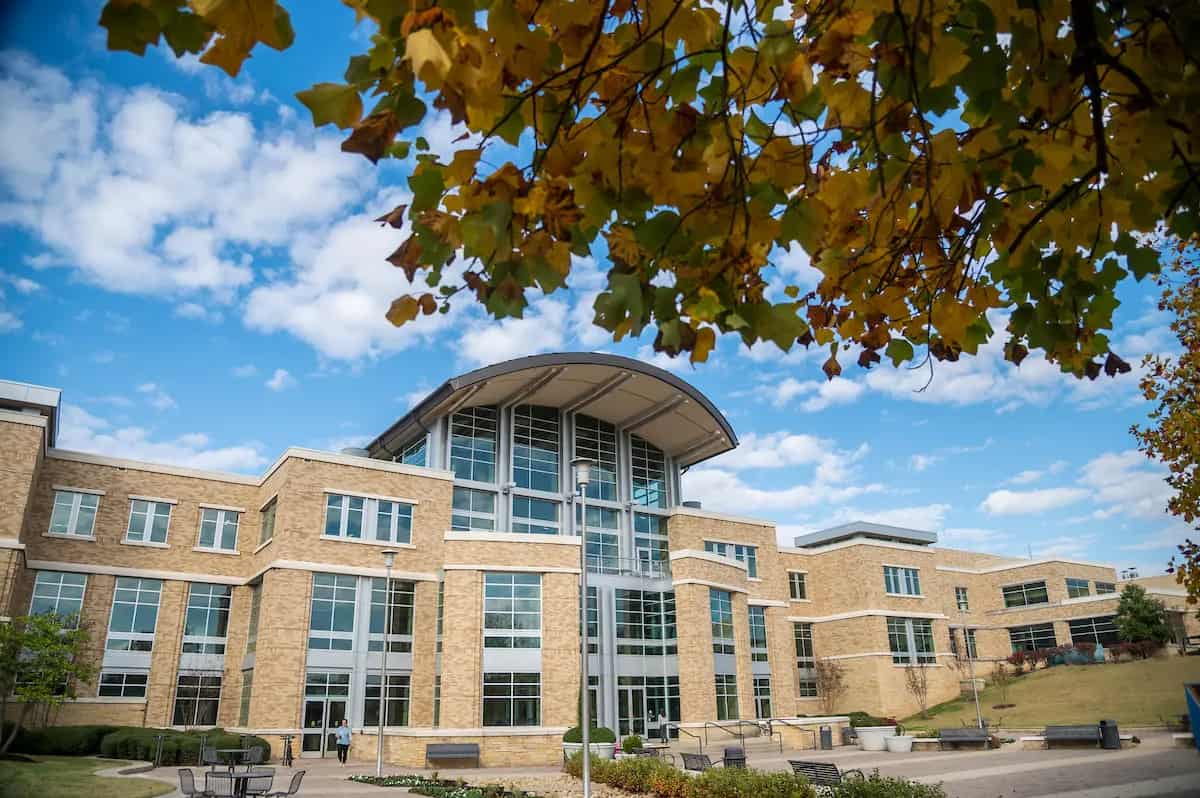
A good deal of what a visitor sees today is only a few years old. The Humanities and Social Sciences Building opened in the autumn of 2015 and is the third largest instructional building on a university campus in Arkansas. The Welcome Center was opened with a ribbon cutting on 21 August 2018 — the idea began in 2016 when the university approached Centennial Bank — and its 3,000 square feet hold a bank branch, a meeting area and removable walls.
The Red Wolf Convention Center and Embassy Suites, begun in 2018 south of Centennial Bank Stadium, held its grand opening on 5 March 2020 with 203 suites and a 40,000-square-foot convention centre. The stadium itself was expanded with a new press box, suites and club seating.
On the residential side, living-learning communities such as the Honors LLC, together with the opening of Sorority Row and The Circle, produced an all-time record for the on-campus student population. Getting around became easier in 2017, when a new street with a pedestrian and biking trail opened, connecting Aggie Road with University Loop West on the south-west side of campus.
And one small detail says a lot about how the institution sees itself: in 2008 the long-time ASU Indians mascot was retired, and the teams have been the Red Wolves ever since.
Timeline
| Year | Event |
|---|---|
| 1909 | Act 100 of the 37th Arkansas General Assembly creates the agricultural school, 1 April |
| 1910 | First classes open 3 October in the Elks Lodge Hall above a jewellery store at Washington and Main — 189 students, eight faculty |
| 1923 | An Arkansas National Guard unit (Battery C, 206th Coast Artillery, Anti-Aircraft) is assigned to the school; the new Armory holds the largest gymnasium in the state |
| 1925 | The legislature changes the school’s name, formally recognising its junior college status |
| 1928 | The Higher Learning Commission begins the continuous accreditation that still stands today |
| 1931 | A fire in the early hours of 12 January destroys the Administration and Classroom Building; classes continue on schedule |
| 1932 | Wilson Hall opens; the first four-year degrees are awarded |
| 1933 | The school becomes Arkansas State College; the Wilson Award is established |
| 1936 | ROTC is established as an Artillery unit on 20 January |
| 1941–1945 | Enrolment falls to a low of 114 students; the campus trains several military units |
| 1955 | First master’s programs; Walter Strong, Fred Turner and Larry Williams become the first Black students |
| 1967 | On 17 January the institution becomes Arkansas State University |
| 1970 | The football team wins the national championship; Dr. Calvin Smith becomes the first Black faculty member |
| 1972 | Hill wins bronze in the 110-metre hurdles at the Munich Olympics |
| 1984 | Al Joyner (triple jump gold) and Earl Bell (pole vault bronze) at the Los Angeles Olympics; the university marks its 75th anniversary |
| 1987 | The ASU Convocation Center opens |
| 1994–1995 | President Bill Clinton dedicates the completed library expansion — the first sitting President to visit the campus |
| 2006 | The ASU system office is created; Jonesboro gets its first campus chancellor |
| 2008 | The mascot changes from the ASU Indians to the Red Wolves |
| 2016 | Wilson Hall is rededicated on 2 June as the NYITCOM site — the state’s second medical school |
| 2017 | The Circle opens on 7 August; Campus Querétaro opens in September |
| 2018 | On 18 December, Carnegie places the university in "Doctoral Universities: High Research Activity" |
| 2021 | The Windgate Center for Three-Dimensional Arts opens 13 September; the Military Science Building is named for Lt. Col. Frederick C. Turner Jr. |
| 2025 | Ground is broken for the state’s first public veterinary college (12 March); women’s basketball reaches March Madness for the first time (20 March) |
| 2026 | Dr. Todd Shields becomes ASU System president on 1 July; on 28 September Dr. Calvin White Jr. is appointed chancellor |
Source: Arkansas State University — History · Updated August 2026
Frequently asked questions
When was Arkansas State University founded?
It developed from an agricultural school founded on 1 April 1909 by Act 100 of the 37th Arkansas General Assembly. The first classes opened on 3 October 1910. It has carried the name Arkansas State University since 17 January 1967.
Why is the school sometimes called "Aggie"?
Act 100 created four high schools to teach agriculture, horticulture and textile manufacturing, and the Jonesboro institution was known as the "Aggie School". The official name changed several times: in 1925 when its junior college status was recognised, to Arkansas State College in 1933, and to Arkansas State University in 1967.
What is the oldest structure on campus?
The Training School Arch, which once marked the entrance to the college and was donated by the Training School, is the oldest structure standing on campus. The Training School taught kindergarten through grade 12 and operated until the 1950s.
When did the first Black students enrol?
In 1955, Walter Strong, Fred Turner and Larry Williams became the first Black students. Williams dropped out before graduating; Strong and Turner became the first Black graduates. Dr. Calvin Smith became the first Black faculty member in 1970, and the four buildings of The Circle are named for the first four African American faculty members.
Has A-State produced Olympic medallists?
Yes. In 1972 Hill earned a bronze medal in the 110-metre hurdles at Munich. At Los Angeles in 1984, Al Joyner won gold in the triple jump and Earl Bell won bronze in the pole vault.
How long has A-State been accredited?
The Higher Learning Commission has accredited the university continuously since 1928. On 18 December 2018 the Carnegie Classification placed it in the "Doctoral Universities: High Research Activity" category.
Who leads the university now?
In May 2026 the Arkansas State University System Board of Trustees appointed Chancellor Dr. Todd Shields as the fourth president of the ASU System, effective 1 July, after nearly four years leading the Jonesboro campus. At the same time the board named Provost and Executive Vice Chancellor Dr. Calvin White Jr. as interim chancellor, and on 28 September 2026 appointed him chancellor.
Curious what the university is like today?
The history explains why the campus looks the way it does. If you are weighing up an application, look next at the rankings, the accreditations and what a year actually costs.