A-State News
A-State Leads a $2.2M NSF Project on Drought-Resilient Rice and Wheat
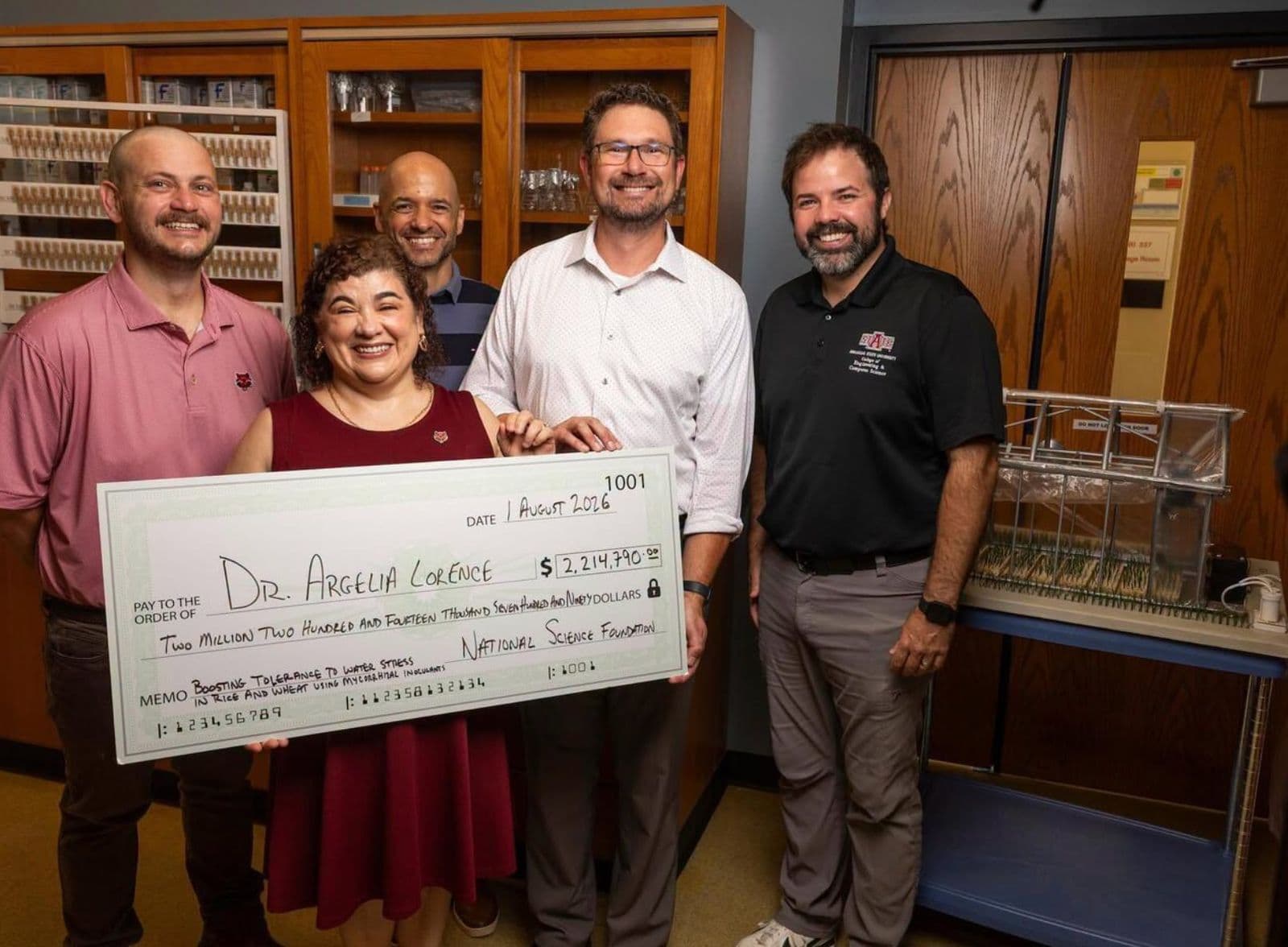
Arkansas State University has received a $2.2 million award from the National Science Foundation to lead a multi-institution project on drought tolerance in rice and wheat. The ceremonial cheque reads $2,214,790, dated 1 August 2026.

What the project studies
The full title is “Collaborative Research: FEC: Boosting Tolerance to Water Stress in Rice and Wheat Using Mycorrhizal Inoculants”, funded through the NSF Established Program to Stimulate Competitive Research (EPSCoR) under its Research Infrastructure Improvement: Focused EPSCoR Collaborations programme.
The team is investigating how arbuscular mycorrhizal fungi — beneficial fungi already present in soil — help rice and wheat withstand water stress. These fungi form symbiotic relationships with plant roots, improving nutrient uptake, water absorption and overall growth.
The work combines plant biology, ecology, physiology, genomics and field research. It also examines the socioeconomic factors that determine whether farmers actually adopt fungal inoculant technology — the part most purely scientific projects leave out.
Who leads it
- Dr. Argelia Lorence, Professor of Metabolic Engineering — principal investigator.
- Dr. Scott A. Mangan, Associate Professor of Ecology — co-principal investigator.
“In this grant we seek to develop strategies to boost the tolerance to water stress in rice and wheat using mycorrhizal fungal inoculants. With droughts becoming more common and severe, developing strategies to keep growing rice with less water is important and the reason why this study is significant,” said Dr. Lorence.
A-State is collaborating with the University of Kansas, the University of Nebraska and Kansas State University over four years, from 1 August 2026 to 31 July 2030. A-State's $2.2 million is part of a $6 million total award across four universities in three states.
“A-State is leading a complex $6M total award across three states and four universities addressing applied research to improve rice and wheat crop yields,” noted Dr. Travis Marsico, vice provost for research, innovation and discovery. “Through this project, Dr. Lorence and her team demonstrate collaborative leadership on a topic important to Arkansans.”
Why this matters if you are considering A-State
Beyond the research itself, the award funds undergraduate and graduate student training, workforce development and educational outreach across Arkansas and the partner institutions. At a US research university, undergraduates working in a laboratory on a live, funded project is ordinary — you do not wait until a master's degree for it.
The grant is also a concrete measure of what Carnegie R2 research university status means in practice. R2 is not only a ranking label: it means the university wins federal awards at this scale and can coordinate four institutions across three states.
For students from rice-growing countries, the subject may be closer to home than the location suggests. Growing rice with less water is a live problem anywhere irrigation is under pressure.
Read more
- Colleges and programmes at A-State
- Graduate entry requirements and assistantships
- A-State rankings and accreditation
Source: Arkansas State University news release, 1 September 2026 — astate.edu.