A-State News
A-State Engineer Wins NSF Award to Make Waste-to-Energy Cleaner
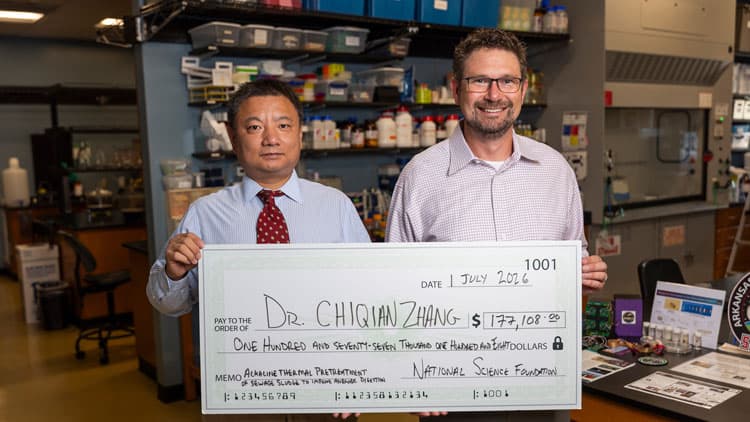
The National Science Foundation has awarded $177,108 to Arkansas State University for research aimed at making waste-to-energy systems more efficient, more sustainable and less harmful to the environment.

The problem
The project is led by Dr. Chiqian Zhang, assistant professor of civil engineering, whose work focuses on anaerobic digestion — the process that uses naturally occurring microorganisms to turn organic waste into renewable energy as methane.
The difficulty is sulphur. Sewage sludge carries a lot of it, and during digestion it produces volatile sulphur compounds. Those compounds cut methane yield, create unpleasant odours and corrode equipment — three effects that together hold back the efficiency of wastewater treatment.
The approach
The research will test a pretreatment method combining heat and calcium oxide (lime) to reduce sulphur compound formation before digestion begins. If it works, it raises renewable methane output while extending the life of treatment infrastructure and lowering environmental impact.
In his own words
On learning of the award, Zhang said: “I felt a mixture of excitement, relief, and a little disbelief. The research plan is ambitious, and receiving the award means that all of the ideas and tasks I put on paper now have to become real experiments and real results. So, after the initial thought of, ‘Wow, I actually got it’ came the next thought: Well, now I have all of the hard work to do.”
Dr. Travis Marsico, vice provost for research, innovation and discovery, said the award reflects the range of research A-State faculty and students pursue as the university’s research activity continues to grow.
What it means for students
A-State is classified Carnegie R2 for high research activity. For undergraduates, the practical value of faculty holding federal grants is early access to real research — something considerably harder to find at a teaching-only institution.
See more about the College of Engineering and Computer Science.
Source: astate.edu